


Executive Summary
Teach to One Roadmap is a personalized learning platform developed by New Classrooms to support K-12 students on their path to math mastery. Built on the belief that each student follows a unique learning journey, the platform evaluates starting points, identifies gaps, and recommends skills to help students progress with purpose.
As the product evolved, the learning model became more powerful, but the user experience no longer made that complexity easy to understand or act upon. Navigation was not always intuitive, the growing number of options increased cognitive overload, and recommendations often lacked the clarity needed to guide next steps for students and teachers.
Onetree partnered with New Classrooms to redesign Teach to One Roadmap, focusing on making the personalized learning model visible, clear, and motivating throughout the experience. By rethinking the navigation structure, visual system, and motivation framework, the redesign helps students and teachers better understand progress, prioritize what to work on next, and move forward with confidence.
The result is a strong foundation for future iterations of the platform, one that aligns pedagogy and experience, and supports scalable, meaningful personalized learning.

The Challenge: Making Personalized Learning Clear and Actionable
Teach to One Roadmap is grounded in a strong pedagogical belief: each student follows a unique learning path. The platform assesses students’ starting points, identifies learning gaps, and recommends skills to support progress toward mastery.
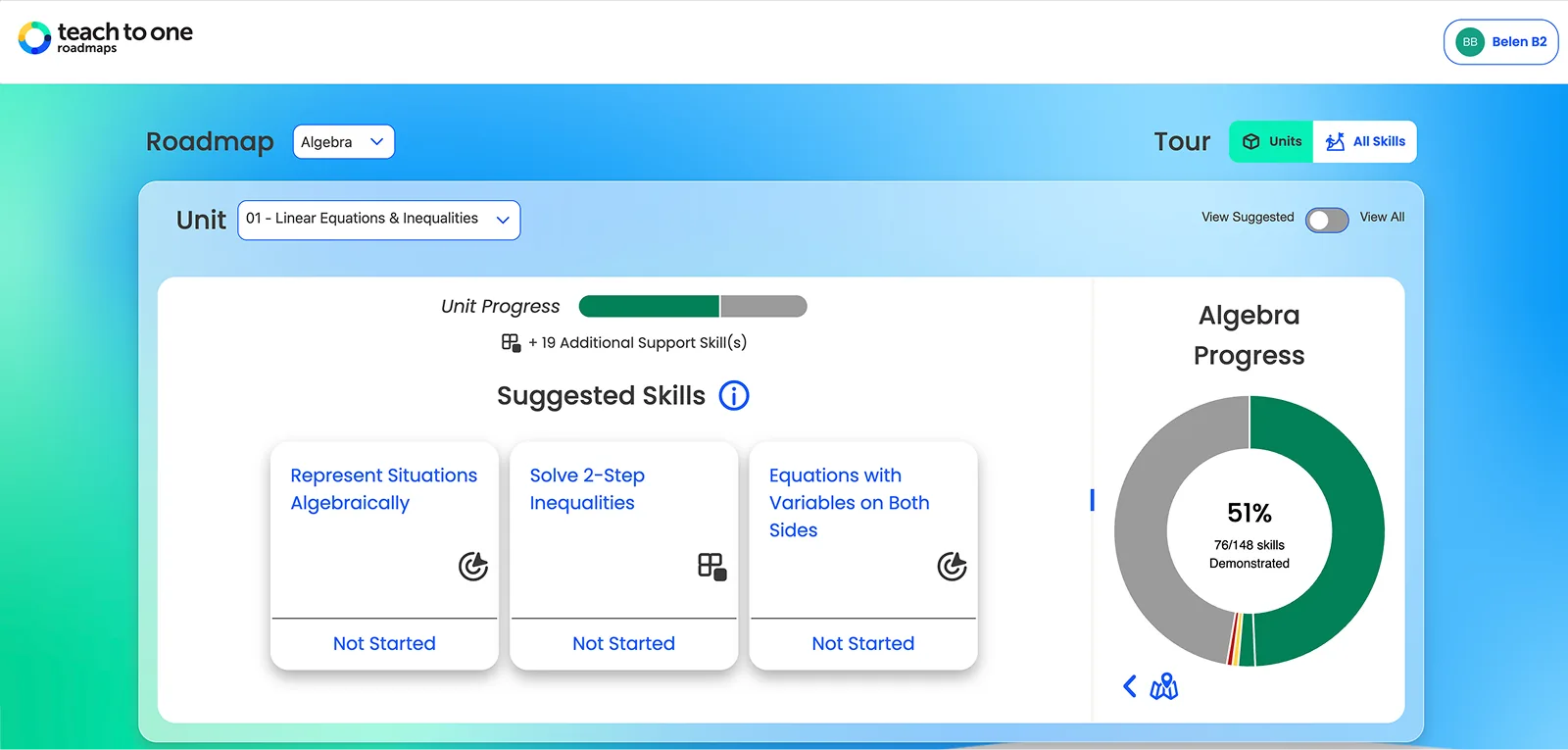
However, this powerful model was not always clearly reflected in the user experience. Navigation was not intuitive, the growing number of options increased cognitive overload, and recommendations often became difficult to interpret. As a result, students and teachers were not always sure what to work on next, or why.
This lack of clarity impacted the overall learning experience. Unclear priorities and limited guidance affected confidence, sustained engagement, and motivation, particularly in environments with diverse learning levels and cognitive maturity.
The core challenge was to translate a complex personalized learning model into an experience that feels clear, actionable, and motivating at every step of the journey.

Our Approach: Translating Pedagogical Complexity into Guided Experiences
Onetree partnered with New Classrooms to redesign Teach to One Roadmap with a clear objective: make the platform’s personalized learning model visible and actionable throughout the student journey.
The approach combined user experience design, visual identity, and pedagogical motivation, focusing on helping students and teachers clearly understand progress, recommendations, and next steps, without increasing cognitive load.
Key Focus Areas
Clarifying the learning structure
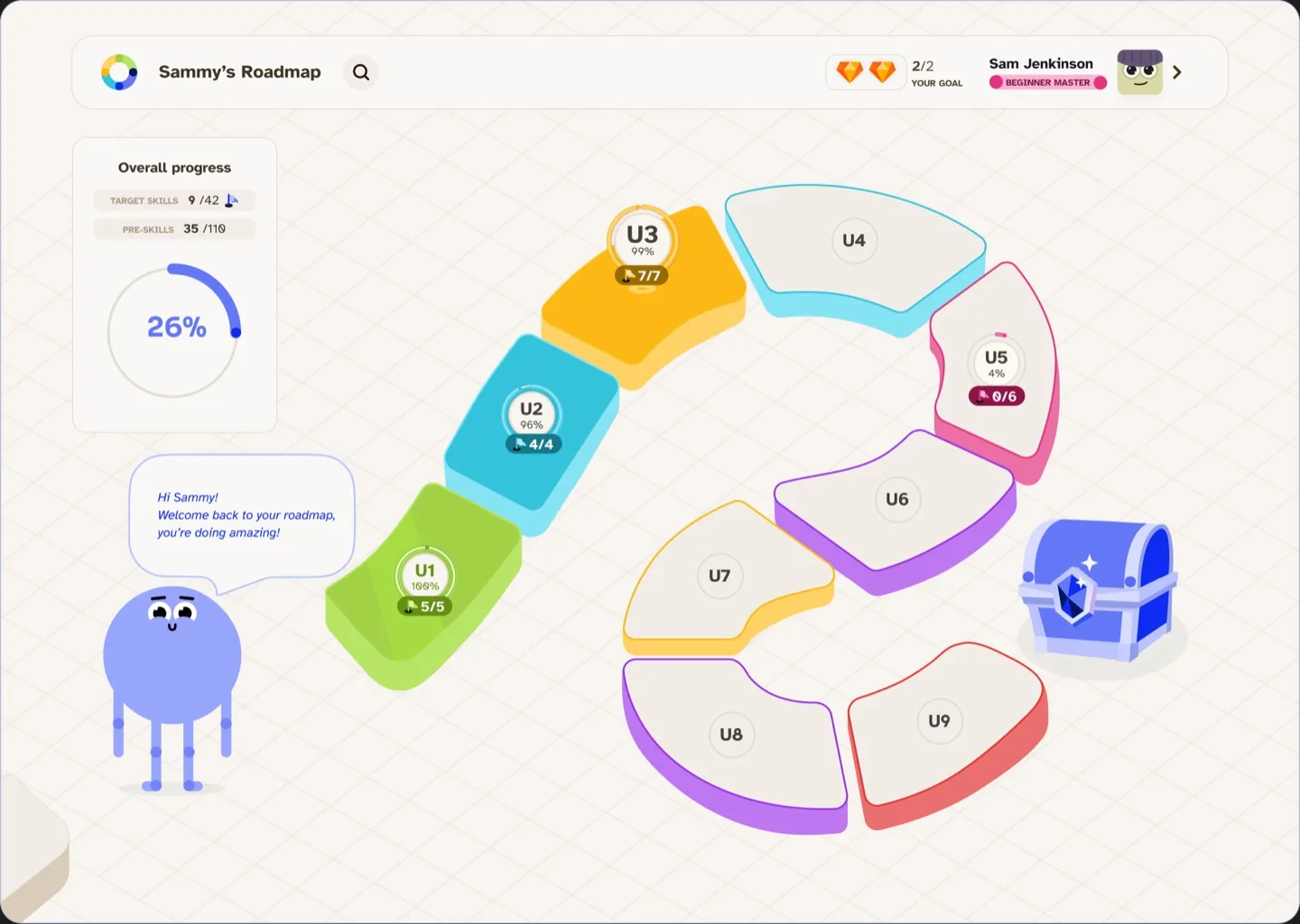
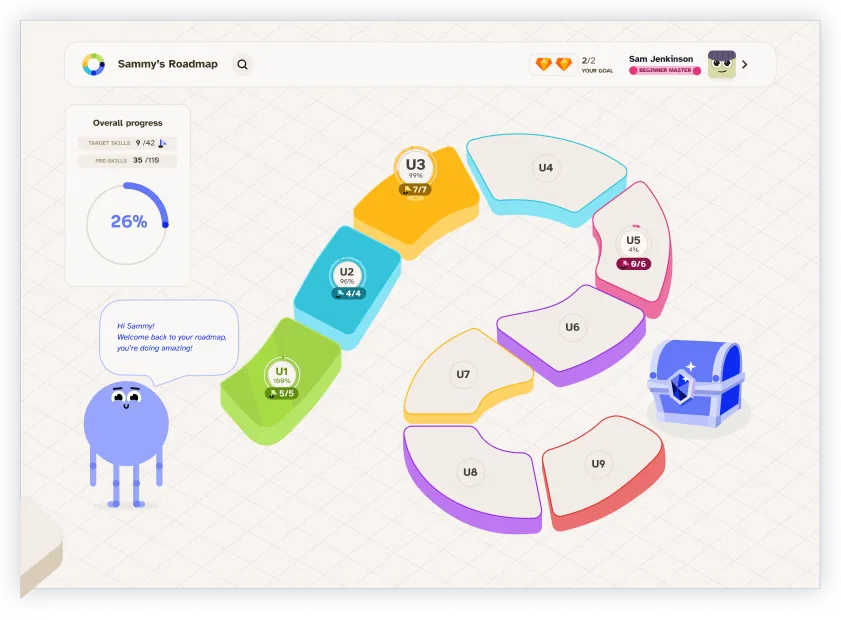
We introduced a layered navigation model (Roadmap → Unit → Skill) to simplify how students move through the platform and reinforce key milestones at each level of the journey.
In this structure, the Roadmap represents the full set of units a student is expected to work through during the academic year, based on their curriculum, while units and skills break that journey into clearer, more actionable steps.
Making recommendations easier to act on
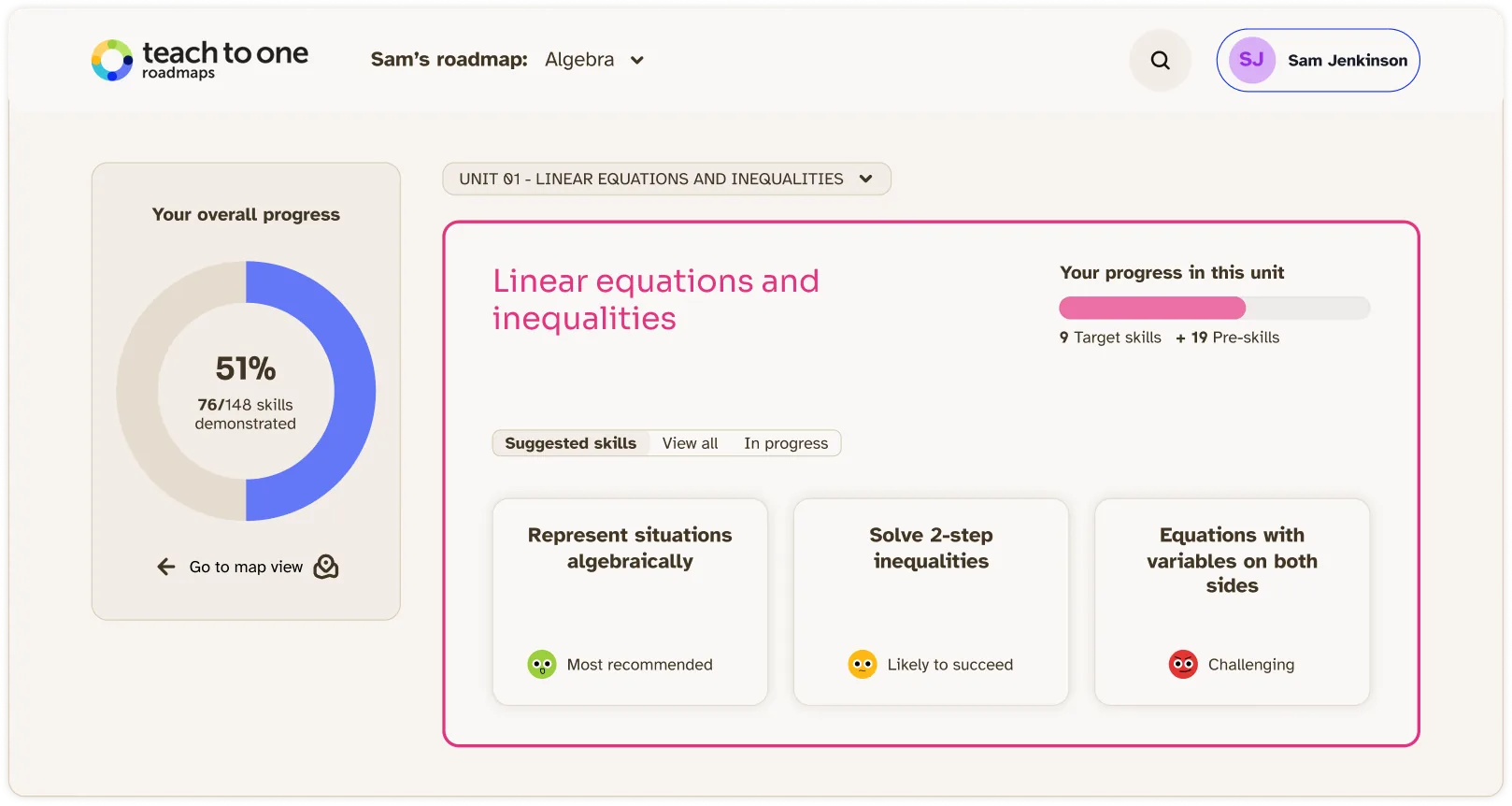
Skills and suggestions were reorganized so students can quickly understand what to work on next, why it matters, and how it connects to their overall progress.
Designing for motivation and confidence
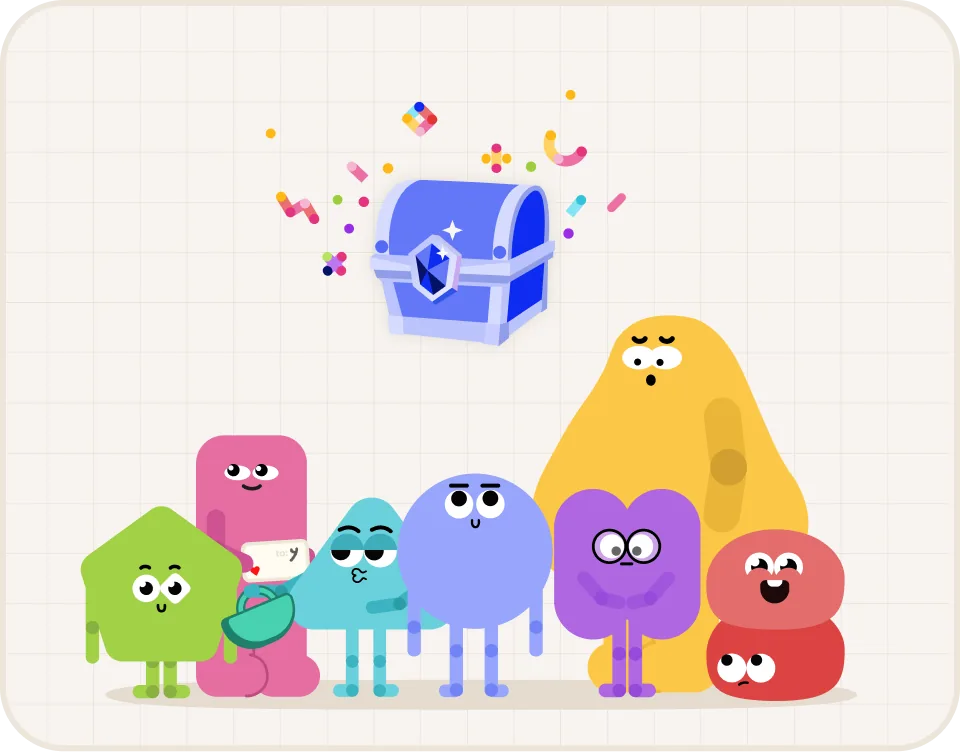
The experience was shaped to support sustained engagement through clear goals, positive feedback, micro-achievements, and empathetic messaging, helping students stay motivated even when learning becomes challenging.
Aligning experience with pedagogical intent
Every design decision aimed to reflect New Classrooms’ core belief that each student follows a unique learning path, ensuring the experience supports personalization without overwhelming learners.
This approach established a solid foundation for a clearer, more motivating, and scalable personalized learning experience.
The Solution: Rebuilding the Roadmap Experience Around Units and Skills
The redesign of Teach to One Roadmap focused on reshaping how students navigate, understand, and act within their learning journey. Rather than adding new functionality, the solution centered on making existing recommendations, progress signals, and learning paths clearer and easier to navigate.
A Structured View of the Learning Journey
To support clarity and orientation, the experience was reorganized around a layered navigation model (Roadmap → Unit → Skill). This structure reflects how students progress through learning goals, helping them understand where they are, what they are working toward, and how individual skills connect to broader objectives.
Clearer Skill Presentation and Guidance
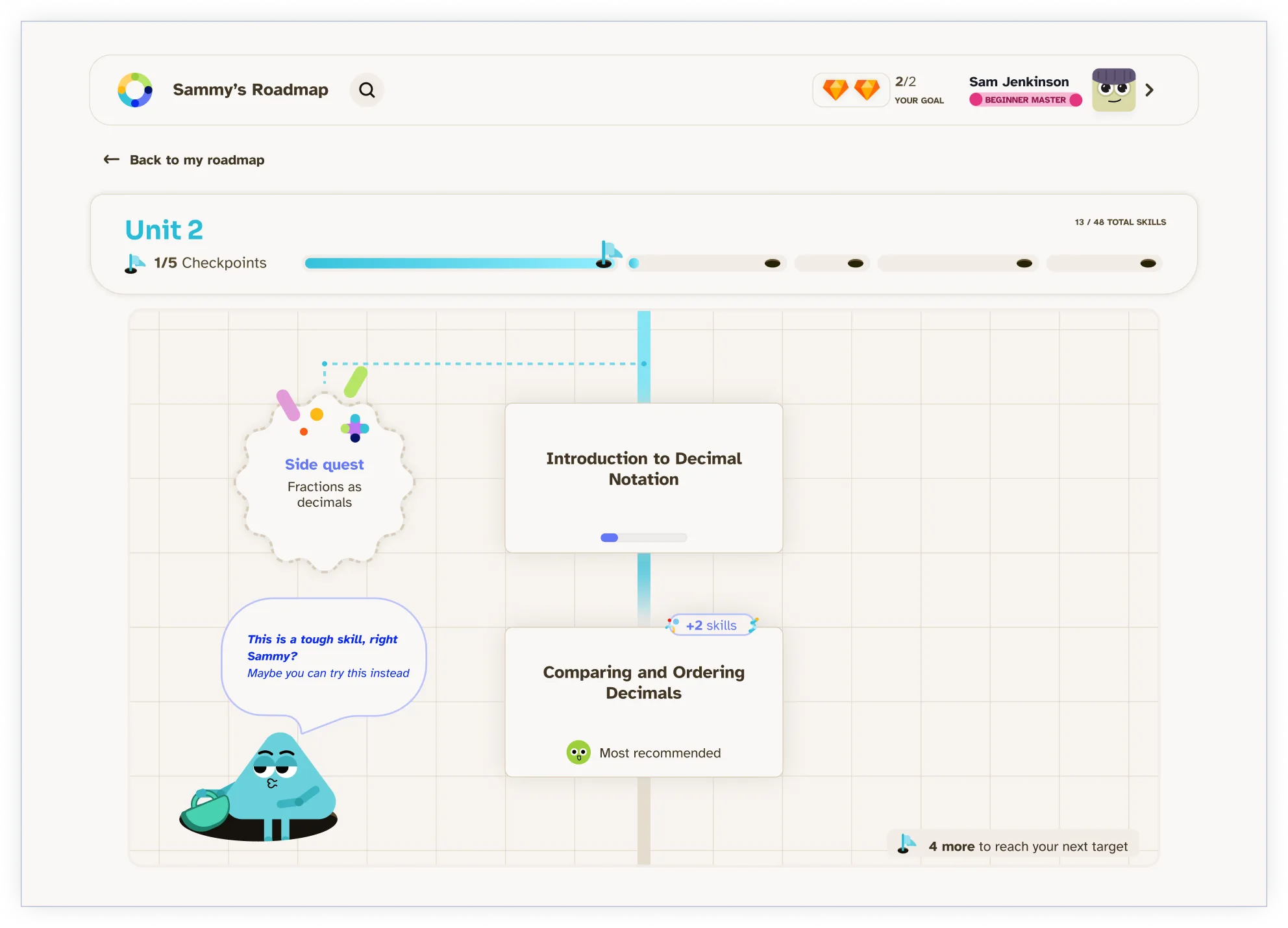
Within each unit, skills were redesigned to make recommendations, progress, and difficulty more visible. Students can quickly distinguish between suggested skills, alternative options, and in-progress work, reducing uncertainty and helping them decide what to work on next with greater confidence.
Designing for Motivation Through Progress
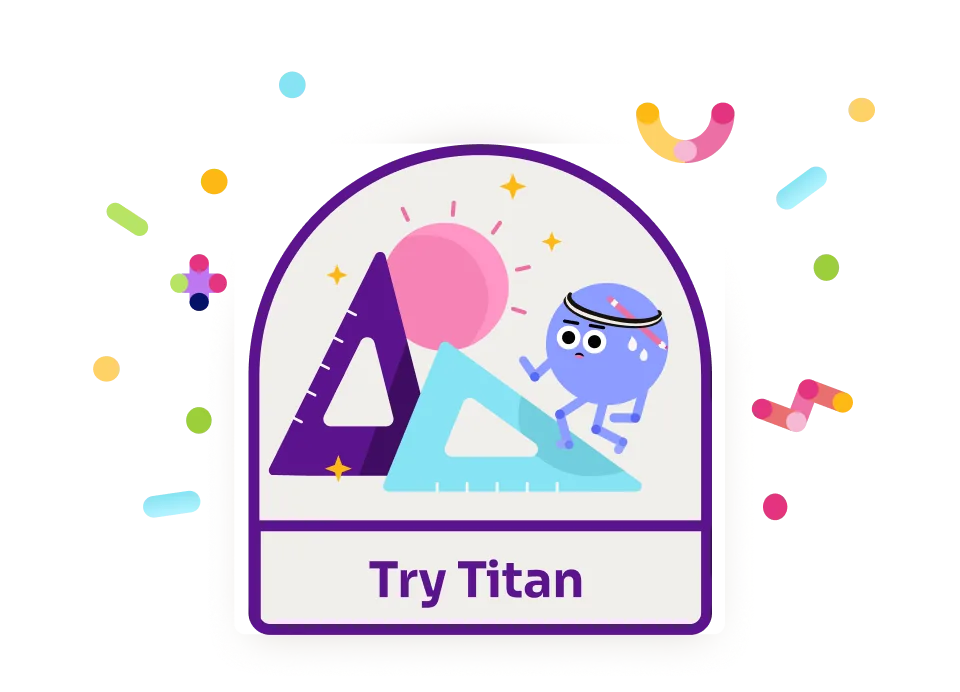
The experience integrates a motivation framework that reinforces progress through micro-achievements, positive feedback, and clear goals. Elements such as checkpoints, badges, side quests, and empathetic messaging help sustain motivation and acknowledge effort throughout the learning process.
Supporting Different Learning Outcomes
The redesigned experience also accounts for different performance scenarios. When students demonstrate mastery, they can move efficiently toward verification. When they struggle, the interface guides them toward targeted prerequisite skills, ensuring that learning remains intentional and supportive rather than discouraging.
Together, these design decisions establish a coherent foundation for Teach to One Roadmap, transforming it into a clearer, more motivating learning experience and enabling future iterations to build on a strong and scalable structure.
Results & Impact: A Clearer and More Confident Learning Experience
The redesign of Teach to One Roadmap established a clear and practical foundation for the platform’s future evolution. By aligning the user experience more closely with New Classrooms’ pedagogical vision, the platform now communicates personalized learning paths in a way that is easier to understand, navigate, and act upon.
Students can more clearly see their progress, understand recommended skills, and recognize how individual actions contribute to broader learning goals. This improved clarity supports greater confidence and engagement, particularly in moments where deciding what to work on next was previously uncertain.
For teachers, the redesigned experience makes student progress and learning priorities more visible, reinforcing the platform’s role as a supportive guide rather than a complex system to interpret.
Across the experience, the introduction of structured navigation, clearer skill presentation, and motivation-focused feedback helps transform Roadmap into a more coherent and motivating learning environment, capable of supporting diverse learning levels and cognitive maturity.
Overall, the project resulted in a strong foundation for scalable, meaningful personalized learning, positioning Teach to One Roadmap as a clearer, more supportive ecosystem for both students and educators as the platform continues to evolve.