


Executive Summary
mEMR is a physician-led healthcare startup with a strong product vision aimed at addressing critical pain points in clinical workflows. While the concept was well-defined at a high level, it had not yet been validated with real users, and moving directly into development posed significant risks in terms of investment, usability, and adoption.
Onetree partnered with mEMR to validate the product concept before committing to development, focusing on understanding physicians’ daily workflows, decision-making processes, and data sensitivities. Through early-stage discovery, UX research, and rapid prototyping, we transformed an abstract idea into a tangible product experience that could be tested and evaluated by potential users.
This approach allowed mEMR to identify issues, refine workflows, and validate key assumptions early, reducing uncertainty and enabling more informed product decisions. By validating the concept without writing a single line of code, the team was able to save time, optimize budget allocation, and build a stronger foundation for future development.

The Challenge: Validating a multi-user healthcare experience before development
Designing digital products for healthcare involves balancing the needs of multiple user groups within highly sensitive and complex environments. For mEMR, the challenge went beyond supporting physicians’ workflows. It also required understanding how patients would interact with the product, share their clinical information, and perceive value in managing their health data through a digital platform.
While the founding team had a clear product vision, the solution existed only as ideas and early diagrams. Moving directly into development would have meant making critical assumptions about how both physicians and patients would use the app, from clinical data entry and exam result uploads to ongoing health monitoring and follow-up.
The core challenge was to validate these assumptions early: ensuring that the product aligned with physicians’ decision-making processes while also confirming that patients would feel comfortable, supported, and motivated to actively engage with their health data. Achieving this required reducing uncertainty across both sides of the experience, before committing time and budget to development.
The Solution: Validating value and usability through research-driven product exploration
To address the complexity of designing for both physicians and patients, Onetree led a comprehensive discovery and UX research process focused on understanding real-world behaviors, expectations, and constraints across both user groups. The goal was to validate the product concept before development, ensuring it delivered meaningful value on all sides of the experience.
For physicians, the research explored clinical workflows, decision-making processes, and the types of data required to support patient follow-up without adding friction to their daily practice. For patients, the focus was on how they would enter and manage clinical information, upload exam results, and track their health over time, while feeling confident, supported, and in control of their data.
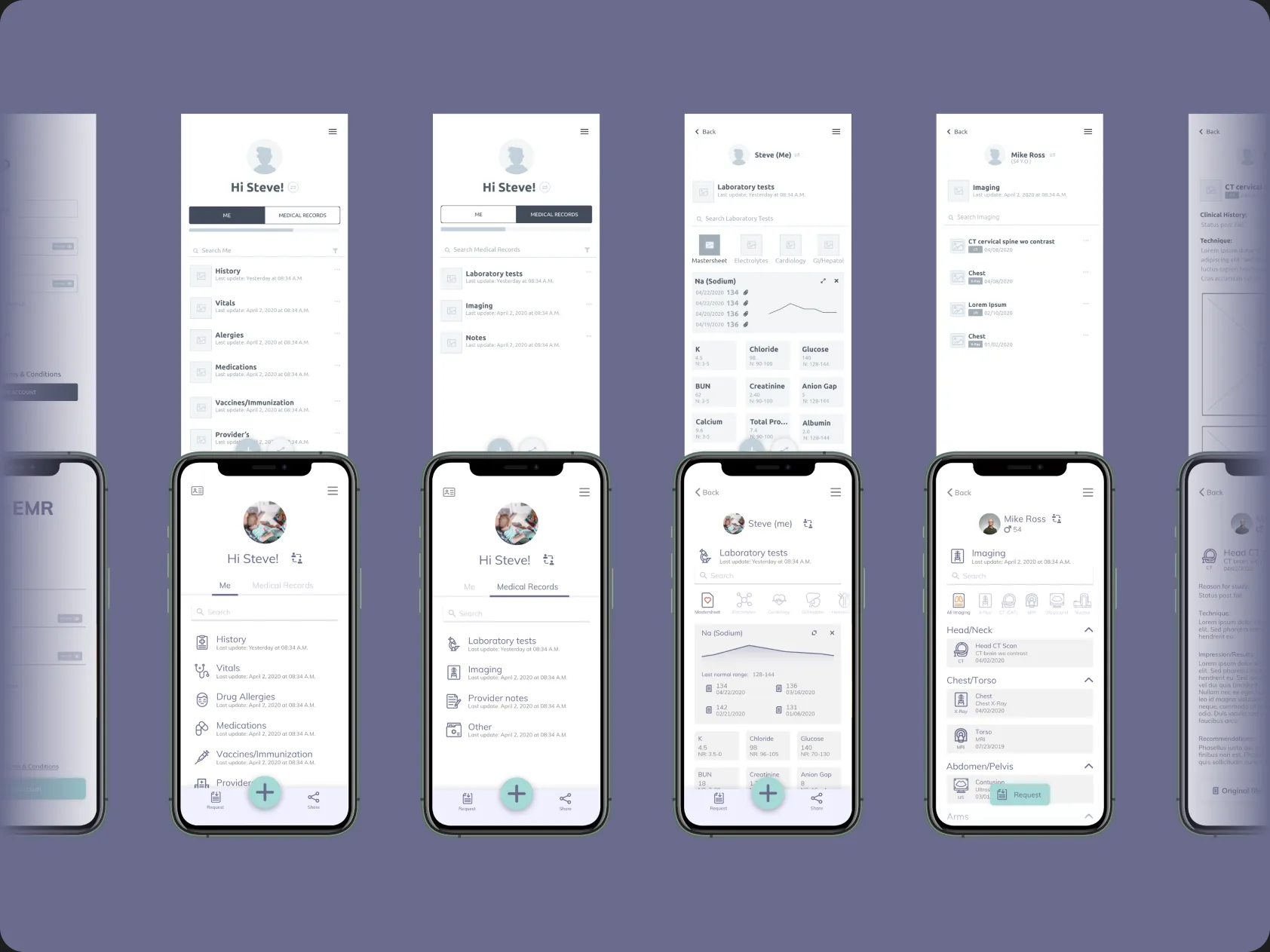
Insights from this research were translated into high-fidelity interactive prototypes that simulated the end-to-end experience of the product. These prototypes allowed stakeholders and potential users to experience the workflow firsthand, test key assumptions, and identify usability issues long before development began.
By using prototyping as a strategic validation tool, mEMR was able to test the concept with real users, gather actionable feedback, and refine the product vision, without writing a single line of code.
Results & Impact: Reducing risk and enabling confident product decisions
Through early validation and user-centered discovery, mEMR was able to transform an abstract product idea into a tangible, testable experience before committing to development. This approach allowed the team to surface potential issues, refine workflows, and align the product vision with real user needs at an early stage.
By validating the concept through interactive prototypes instead of code, mEMR significantly reduced the risk of building misaligned features, avoided costly rework, and gained clarity on what truly mattered to both physicians and patients. The prototypes themselves became a strategic asset, enabling internal alignment and external validation with potential users.
This process ultimately helped mEMR save time and optimize budget allocation, while establishing a stronger foundation for future development. With key assumptions validated and uncertainties addressed early, the team was able to move forward with greater confidence, supported by evidence-based product decisions rather than hypotheses.